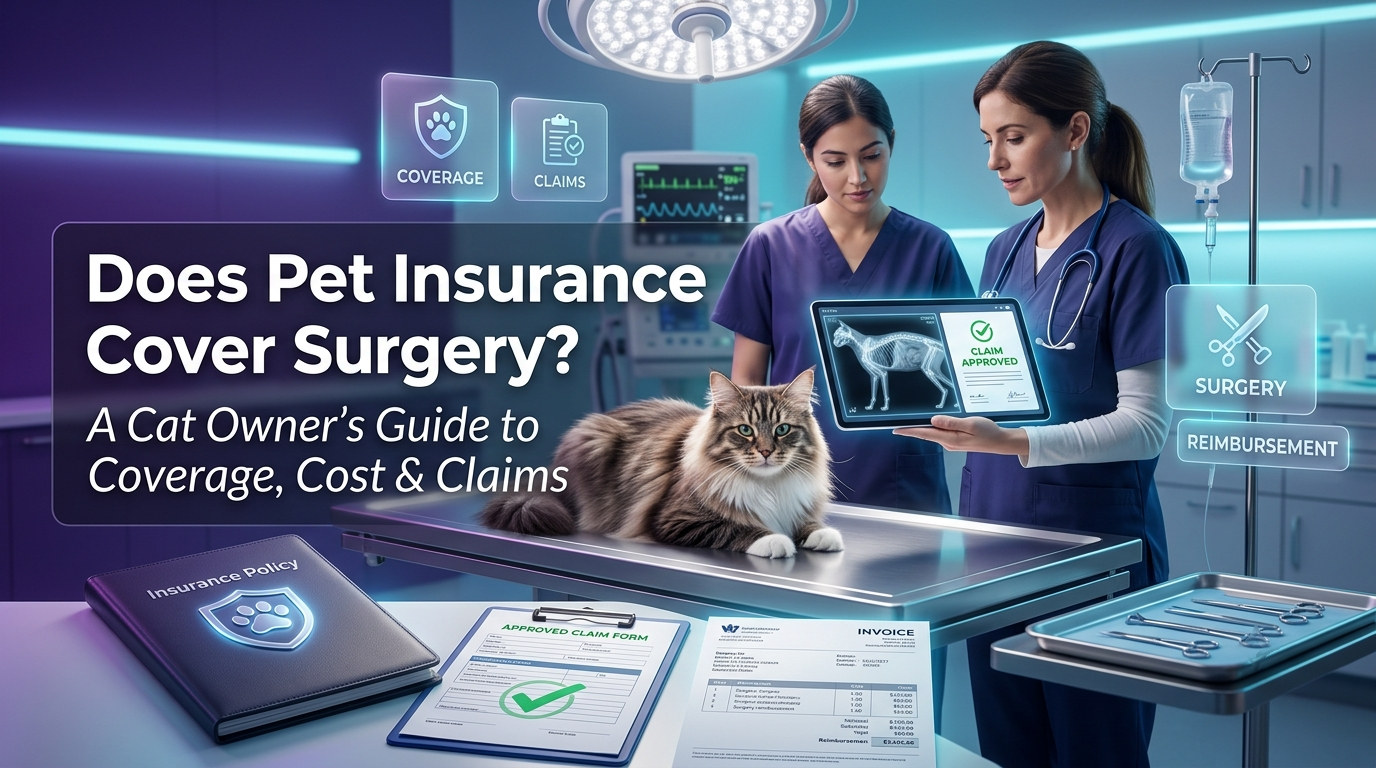
A cat parent's worst 2 a.m. moment usually starts the same way: something's wrong, the emergency vet mentions surgery, and somewhere in that conversation a number comes up that's a lot bigger than expected. A single emergency procedure can run $1,500 to $5,000 in the U.S., which is exactly why so many cat owners end up searching for pet insurance for cats right after, rather than before, that moment happens.
So does coverage actually kick in for surgery? Generally, yes, most comprehensive plans handle it. But "generally" is doing some work in that sentence, and the fine print is where owners get tripped up. This guide walks through what actually gets covered, what doesn't, what real procedures cost with and without a policy, and how to pick coverage that won't let you down when your cat needs it most.
A standard accident-and-illness policy, the most common tier of pet insurance for cats, is built around one idea: the surgery has to be medically necessary, not optional. That covers more ground than people usually expect.
Emergency and accident cases sit at the core of any decent plan. Getting hit by a car, falling from a height, swallowing something like a hair tie or a length of string, a fight with another animal, the surgery to fix any of that is covered, including foreign body removal, wound repair, and setting a fracture. Foreign body ingestion in particular shows up constantly in claims data for cats, more than most owners realize until it happens to their own cat.
Illness-driven surgery is where cat health insurance really earns its premium. Tumor removal, a urinary blockage (extremely common and expensive in male cats specifically), an intestinal blockage, or removing a gallbladder or kidney stone all fall under this category on a comprehensive plan.
Orthopedic surgery happens less often in cats than in dogs, but it's not rare. Torn ligaments, broken limbs, and hip dysplasia repairs are typically covered, provided nothing about the condition was already on record before the policy started.
Cancer surgery deserves its own mention, since cancer becomes a real concern as cats age. Most strong policies cover the diagnostic workup, the tumor removal itself, and chemotherapy or radiation if that's part of the treatment plan. None of this happens under an accident-only plan, though, so if surgery coverage actually matters to you, a comprehensive accident-and-illness policy is the one to shop for.
A few categories are excluded across nearly every insurer, and it's worth knowing them upfront so a claim denial doesn't come as a surprise.
Cosmetic and elective procedures, such as declawing, ear cropping, or tail docking, aren't covered by any policy, regardless of provider. Pre-existing conditions are excluded the moment symptoms show up before your policy start date or during the waiting period, which is exactly why getting a kitten insured early matters so much.
Routine spay or neuter surgery falls outside a basic accident-and-illness plan. Some of the stronger cat insurance companies, including Lemonade, Spot, and Pets Best, offer a wellness add-on that reimburses this cost separately. Breeding-related surgery, including C-sections tied to intentional breeding, is generally excluded unless you're carrying a specific breeding policy.
Reading the policy carefully matters here, because cats face a different set of common emergencies than dogs do, and generic pet insurance marketing doesn't always spell that out clearly.
Urinary obstruction is the single most frequent surgical claim for cats in the U.S. Male cats especially can develop a blockage that stops them from urinating entirely, a genuine emergency that needs immediate surgery, typically costing $2,000 to $4,000. Foreign body removal comes in second, unsurprising given how many cats treat string, rubber bands, and tinsel like toys. That surgery usually runs $1,500 to $3,000 and falls squarely under standard accident coverage.
Because of this, it's worth checking that any policy you're considering explicitly addresses feline-specific risks rather than reading like a copy-pasted dog policy. Hereditary conditions like hypertrophic cardiomyopathy, which shows up disproportionately in Maine Coons and Ragdolls, dental disease requiring surgery, and coverage that doesn't cut off at a certain age are all worth confirming directly.
Numbers tell this story better than generalities do. Routine spaying without insurance runs roughly $300 to $600, but that's the cheap end. Emergency and illness-related surgeries are a different story entirely.
Foreign body removal: roughly $1,500 to $3,500 uninsured, versus about $150 to $350 out of pocket with a strong 90% reimbursement plan. Urinary blockage surgery: about $2,000 to $4,000 uninsured, versus roughly $200 to $400 with insurance. Cancer tumor removal: typically $2,500 to $6,000 uninsured, versus around $250 to $600 with coverage. Broken leg repair: commonly $2,000 to $5,000 uninsured, versus about $200 to $500 with insurance.
With a solid policy offering 80% to 90% reimbursement and a typical annual deductible somewhere between $100 and $500, the difference isn't marginal, it's the gap between a manageable bill and a genuinely painful financial decision.
Not every plan is built the same way, and if surgical protection is your main priority, a few specific features matter more than the rest of the marketing copy. A high annual limit, ideally $10,000 or more. A handful of insurers, including Spot and Trupanion, offer unlimited annual payouts, which removes the cap question entirely. A short accident waiting period, ideally two to three days, with illness coverage typically starting around fourteen days later. Explicit coverage for hereditary and congenital conditions tied to your specific breed. Direct vet payment, offered by some top-tier providers, which removes the need to front the entire bill yourself. An 80% to 90% reimbursement rate, which is where the real financial protection during a major surgery comes from.
If you've just brought home a kitten, you're sitting on the best possible timing for this decision. Enrolling at eight weeks old, before anything has had a chance to go wrong, sets up decades of better coverage.
Premiums are lowest at this stage by a wide margin. A plan for a two-month-old kitten can run as little as $10 to $15 a month, compared to $50 or more for the same coverage on a ten-year-old cat. There's also no medical history yet, meaning nothing gets excluded as pre-existing once the waiting period passes. Many kitten owners pair their policy with a wellness add-on that reimburses spay or neuter surgery, vaccinations, and microchipping in that first year, which can make the whole package feel close to free once you tally up what it would have cost otherwise.
Think of kitten insurance less as a monthly expense and more as a foundation you're laying for whatever surgery might come up over the next fifteen or twenty years.
Most denials trace back to a handful of avoidable mistakes rather than genuine coverage gaps. Incomplete medical records. Insurers will request your cat's full history for any claim, so gaps or missing visits can slow things down or raise questions. Filing during the waiting period. A surgery that happens before your waiting period ends won't be covered, no matter how legitimate the emergency. Skipping pre-authorization on a planned, expensive procedure. For anything over roughly $1,000 that isn't an emergency, calling your provider first can prevent a surprise denial. Vague vet documentation. Make sure your vet's notes clearly establish medical necessity rather than leaving room for a surgery to be read as elective.
For most owners, yes, and it's not particularly close. A single major surgery over your cat's lifetime can easily cost more than a decade of premiums combined. If you've got a young, healthy cat, a standard accident-and-illness plan is close to a no-brainer from a purely financial standpoint. If your cat is already older, look specifically for a provider with no upper age limit and clear senior-cat terms.
The best time to shop for coverage is before anything goes wrong, not after. Get quotes from at least three providers, compare their annual limits, waiting periods, and exclusions side by side, and aim for something offering at least 80% reimbursement with a $10,000-plus annual cap. Your cat can't make that decision for you, but having the right policy in place means you'll never have to choose between your cat's life and your bank account when a surgery becomes necessary.