
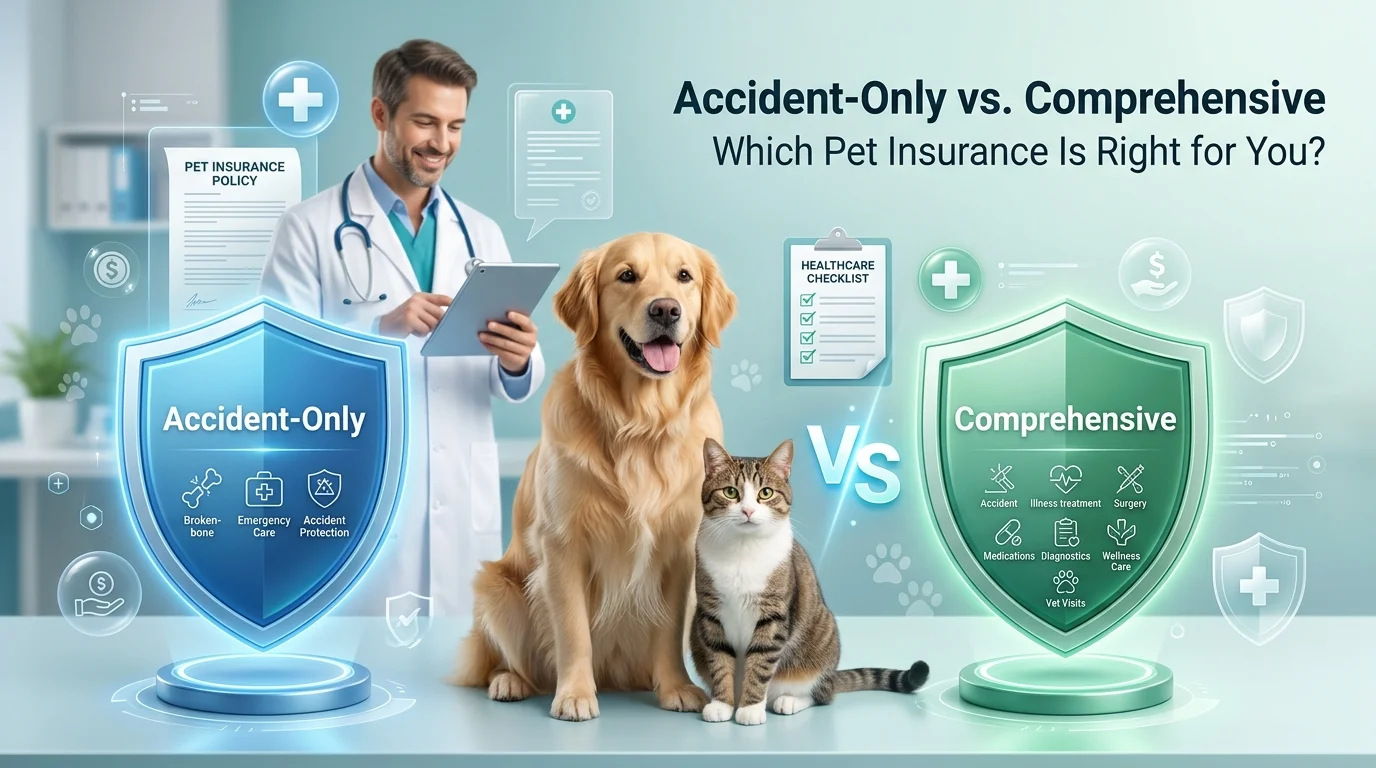
Direct Answer: For Best Pet Insurance, choose Comprehensive for full Pet Insurance Coverage (accidents + illness). Accident-only is cheapest for Pet Insurance Cost ($10-$20/mo), but for Multi Pet Insurance households, comprehensive with a multi-pet discount gives best value.
Vet bills have a way of escalating fast. A single emergency visit can land anywhere from $3,000 to $7,000, and that reality is what pushes most pet owners toward shopping for coverage in the first place. Once you start comparing plans, though, you run into a fork in the road almost immediately: accident-only or comprehensive. They sound similar on a pricing page, but the gap between them is bigger than most people expect, and picking the wrong one can mean discovering a coverage hole at the worst possible time.
This piece walks through what each type actually includes, what they cost in practice, which U.S. companies sell both side by side, and how to figure out which one fits your specific pet rather than just going with whichever sounds cheaper.
Accident-only is exactly what it sounds like: the cheapest, most stripped-down version of pet insurance, built to pay for injuries and nothing else. That still covers a fair amount of ground, including car accidents, fractures, swallowed objects like socks or string, bite wounds, snake bites or bee stings, a torn ligament from a fall, and accidental poisoning.
What it won't touch is illness, full stop. Cancer, allergies, ear infections, urinary infections, vomiting and diarrhea from something other than an accident, diabetes, none of it is covered, no matter how expensive the treatment gets. That's the tradeoff baked into the low price, and it's a bigger tradeoff than the sticker price alone suggests.
This tier tends to make sense in two situations: an older pet that no longer qualifies for a comprehensive policy, or an owner working with a genuinely tight budget who mainly wants a safety net against a catastrophic accident. Pricing typically runs $10 to $20 a month for dogs and under $10 for cats.
Comprehensive, sometimes called accident-and-illness coverage, is what the large majority of pet owners actually end up buying, and it's the tier most vets point people toward. It includes everything accident-only covers, then adds illness on top: cancer, allergies, infections, digestive problems, urinary tract issues, hereditary and congenital conditions like hip dysplasia or heart disease, diagnostics such as X-rays and bloodwork, surgery and hospitalization, prescription medication, and chronic disease management like arthritis or diabetes care.
Some comprehensive policies also offer an optional wellness add-on for routine expenses, but even without that extra layer, the base plan alone covers a dramatically wider range of scenarios than accident-only ever will. The monthly cost is higher, but the coverage is on an entirely different scale, not just marginally better.
Monthly cost, dogs: $10 to $20 vs. $25 to $60. Monthly cost, cats: $6 to $15 vs. $15 to $40. Accident coverage: Included vs. Included. Illness coverage: Not included vs. Included. Cancer coverage: Not included vs. Included. Hereditary conditions: Not included vs. Included on most plans. Best suited for: Tight budgets, senior pets vs. Most owners, puppies and kittens.
The monthly price gap between the two tiers usually lands somewhere around $15 to $30. Set against that: a single cancer treatment can run $5,000 to $10,000, an amount accident-only will never touch regardless of how long you've been paying premiums.
Industry-wide estimates put average accident-only pricing around $16 a month for dogs and under $10 for cats, which tracks with how narrow that coverage is, it excludes the reason most pets end up at the vet in the first place. Comprehensive plans average meaningfully higher, often in the neighborhood of $50 a month for dogs and $30 for cats, though your specific quote depends heavily on breed, age, zip code, and the deductible you select. A French Bulldog insured in California, for instance, will typically cost more to cover than a Beagle in Ohio, simply because the breed carries more known health risk.
If you own more than one pet, it's worth specifically asking about multi-pet insurance rather than buying separate policies. Most insurers knock off somewhere between 5% and 15% per additional pet, and you get the added convenience of one account and one renewal date instead of juggling several. Over a year, that discount can add up to real money, especially in a two- or three-pet household.
One more lever worth knowing about: raising your deductible to something like $500 and dropping your reimbursement rate to 70% can cut your monthly premium by roughly 30 to 40%, while still leaving you protected against the bills that actually matter.
A handful of major providers sell both tiers side by side across most of the country, which makes direct comparison easier than mixing and matching insurers.
Pets Best sells both accident-only and comprehensive coverage nationwide, with accident-only starting around $8 a month. Its comprehensive plan is frequently cited for strong value, and it offers a solid multi-pet discount along with no upper age limit for enrollment. ASPCA Pet Health Insurance covers both tiers as well, and its comprehensive plan stands out for flexibility, including behavioral treatment, dental disease, and alternative therapies. It also offers a 10% multi-pet discount.
Embrace sells accident-only and comprehensive plans in all 50 states, and its comprehensive tier includes a diminishing deductible that drops by $50 for every claim-free year. Hereditary conditions are included, and multi-pet discounts run roughly 5% to 10%. Nationwide is the largest pet insurer in the country and, notably, the only major national option that extends coverage to birds and exotic pets alongside cats and dogs, useful if your household includes more than the usual two species. Spot offers both tiers with an unlimited annual payout option and no per-incident caps, which makes it a strong pick for a dog prone to expensive emergencies. It also offers a 10% multi-pet discount.
Accident-only tends to make sense when your pet is quite old, often past fourteen, and no longer eligible for comprehensive coverage, or when your budget genuinely can't stretch past roughly $20 a month and you'd rather self-fund illness costs while insuring against a major accident.
Comprehensive is the better fit for a puppy or kitten just starting its coverage history, for breeds with known illness risk like Bulldogs, German Shepherds, Persians, or Maine Coons, and for anyone who wants protection that actually extends to cancer treatment. It's also the more sensible base for a multi-pet household, since bundling full coverage for every pet under one account tends to be where the real savings show up.
For most owners, comprehensive ends up being the more rational choice simply because the majority of vet bills come from illness, not accidents. A single illness claim can offset the entire price difference between the two tiers, sometimes several times over.
Best Pet Insurance 2026 Rankings | Check Pet Insurance Cost by breed | Full Pet Insurance Coverage breakdown | Compare Pet insurance quotes | Save with Multi Pet Insurance discounts
Accident-only looks appealing on a pricing page because the number is small, but the coverage gap underneath that number is substantial for most households. A reasonable way to think about it: accident-only is like a car insurance policy that pays for tire damage but walks away the moment the engine fails. Comprehensive covers the whole vehicle.
If your budget allows it, comprehensive is generally the stronger long-term choice, since it's the only tier that protects against both accidents and the illnesses that make up the bulk of real-world vet bills. And if you're managing coverage for more than one pet, asking specifically about a multi-pet discount from providers like Pets Best, ASPCA, or Embrace is one of the easiest ways to bring the total cost down without giving up coverage on any individual pet. Getting a few real quotes for your specific breed and zip code, before any condition has a chance to develop, remains the best way to lock in the right policy.