
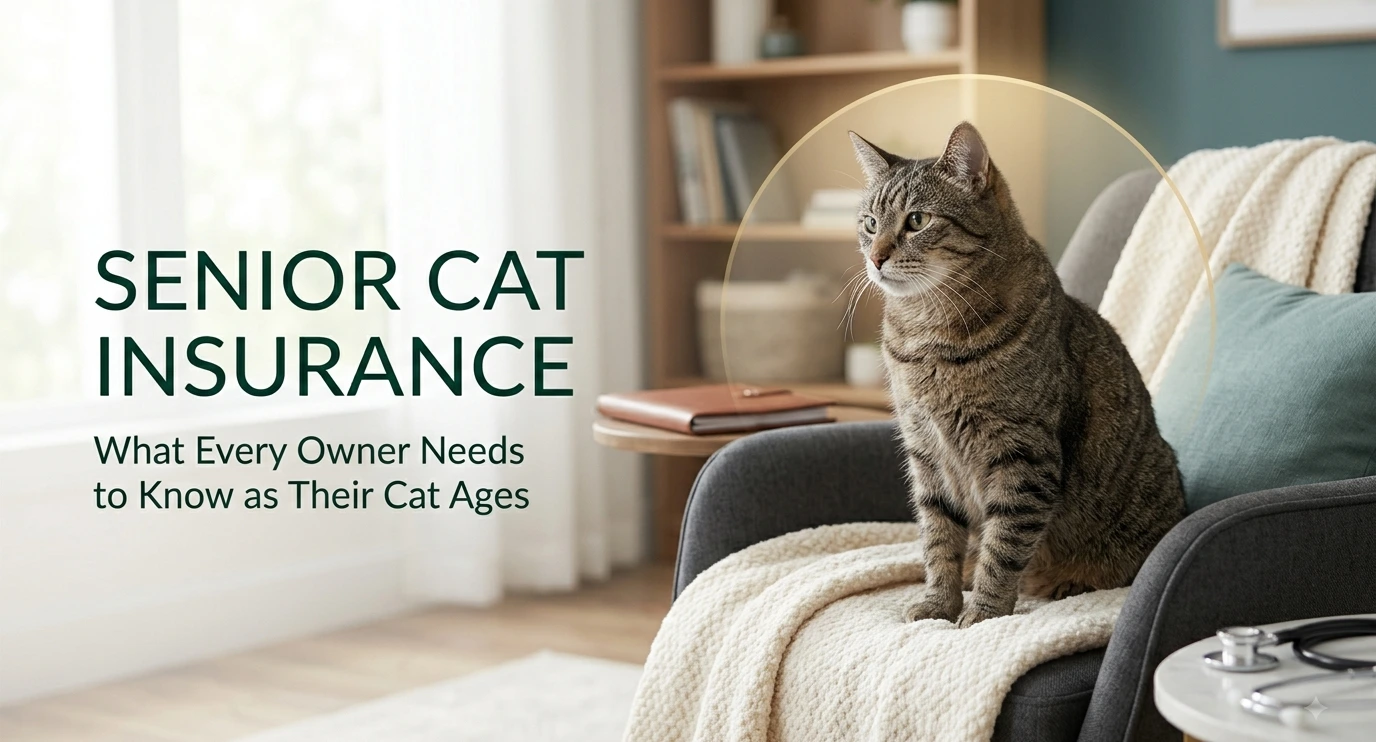
There's a particular kind of worry that sets in once a cat crosses into its senior years. The same animal that once tore across the living room chasing a laser pointer now naps more, moves a little slower, and occasionally skips a meal for reasons that aren't always obvious. Older cats are more prone to kidney disease, hyperthyroidism, arthritis, dental disease, and cancer — and the vet bills that come with managing these conditions can be substantial and ongoing. This is the exact situation senior cat insurance was designed for.
If you've owned your cat since it was young, you may have started with a basic policy, or perhaps skipped coverage entirely because your cat was healthy and insurance felt unnecessary. Either way, this guide walks through how coverage for older cats works, how it compares to kitten insurance and general cat insurance plans, where to find cheap cat insurance for a senior cat without settling for weak coverage, and what to know if you're insuring a cat that's aging without having had pet insurance for kittens earlier in life.
Insurers price policies based on risk, and risk increases with age. A cat between eight and ten years old is statistically far more likely to develop a chronic condition than a two-year-old cat, and insurers account for that in both pricing and policy structure. This is why senior cat insurance typically looks different from the kind of plan you'd buy for a young, healthy cat.
Several factors shift once a cat is classified as a senior by an insurer (a threshold that usually falls somewhere between seven and ten years old, depending on the provider):
None of this means senior cats are impossible to insure — far from it. It simply means owners need to approach the search with a slightly different set of priorities than they would for a kitten.
Coverage details vary by provider, but most policies built for older cats fall into a similar structure. A reasonably comprehensive plan will include:
What it typically won't cover is anything that qualifies as pre-existing — meaning a condition your cat was already showing symptoms of, or had been diagnosed with, before the policy began. This is precisely why timing matters so much when insuring an older cat.
This is the single biggest challenge facing owners who wait until their cat is already a senior to buy insurance. If your cat has already been diagnosed with early kidney disease or a heart murmur, that specific condition will almost certainly be excluded from any new policy you purchase, regardless of the provider.
This is where the earlier decisions in a cat's life carry long-term weight. Owners who purchased kitten insurance or general pet insurance for kittens early on, and maintained continuous coverage as their cat aged, are in a much stronger position. Conditions that develop naturally over the years remain covered because they weren't pre-existing at the time the policy started. If you're in that position, the smartest move is usually to keep your existing policy rather than shop around, since switching providers later in life could reintroduce exclusions for anything diagnosed under your current plan.
If you didn't insure your cat early and it's now a senior with no prior coverage, don't assume insurance is pointless — new conditions that haven't yet developed can still be covered going forward. It simply means your policy will exclude anything already present, and you should read the exclusion list carefully before assuming a specific health issue will be handled.
Premiums for senior cats are inherently higher than for kittens, but "higher" doesn't mean you're stuck with an expensive plan. There are real ways to keep costs manageable while still getting meaningful protection.
Rather than guessing at what fits your budget, it helps to run actual numbers. A dedicated pet insurance calculator allows you to enter your senior cat's age, breed, and general health status to estimate realistic premium ranges and compare how different deductible and reimbursement combinations affect your monthly cost — a process not unlike using a car insurance calculator to estimate premiums before choosing coverage for a vehicle.
When you're evaluating cat insurance plans specifically for an older cat, the checklist looks a little different than it would for a kitten. Prioritize the following:
Taking the time to compare two or three providers against this checklist, rather than accepting the first quote you receive, often reveals meaningful differences in what's actually covered for the same monthly price.
If you already have a policy for your cat, switching providers later in life is usually not advisable unless your current insurer has become significantly more expensive or has a poor claims track record. The reason is simple: any condition already noted in your cat's medical history — even something minor — could be excluded as pre-existing by a new insurer, even though it was actively covered under your current policy.
If you're considering a switch, request records from your vet showing exactly what's documented, and compare that against the new provider's exclusion policy before making a final decision. In many cases, staying with your existing insurer, even at a somewhat higher premium, ends up being the more financially sound choice over the long run.
Senior cat care is rarely a single, predictable expense — it tends to involve a combination of monthly medication, periodic bloodwork, and the occasional unplanned emergency. Because of this, many owners choose to think about pet insurance as one part of a broader financial cushion rather than a standalone expense. Some households diversify their savings across a few different channels, whether that's a dedicated emergency fund, a general savings account, or tracking asset values for reference, such as checking gold rates in Qatar or gold rates in Oman if precious metals are part of a household's personal savings approach. These aren't directly related to pet insurance, but for owners thinking holistically about how to prepare for unpredictable costs, having a broader financial cushion — pet care included — tends to reduce stress when a real emergency happens.
Senior cat insurance exists precisely because aging cats face a different set of health risks than young ones, and the financial exposure that comes with chronic illness or cancer treatment can be substantial. If you insured your cat early with kitten insurance or general pet insurance for kittens, staying continuously enrolled is almost always the smarter path as your cat ages. If you're starting from scratch with an older cat, don't assume coverage isn't worth it — it simply requires a more careful read of exclusions, annual limits, and enrollment eligibility.
Whether you're focused on finding cheap cat insurance that still offers real protection, or comparing full-featured cat insurance plans built specifically for aging cats, the right policy comes down to matching coverage to your cat's actual health profile rather than choosing based on price alone. Take the time to run the numbers, read the fine print, and make the decision that protects both your cat's health and your own peace of mind.