
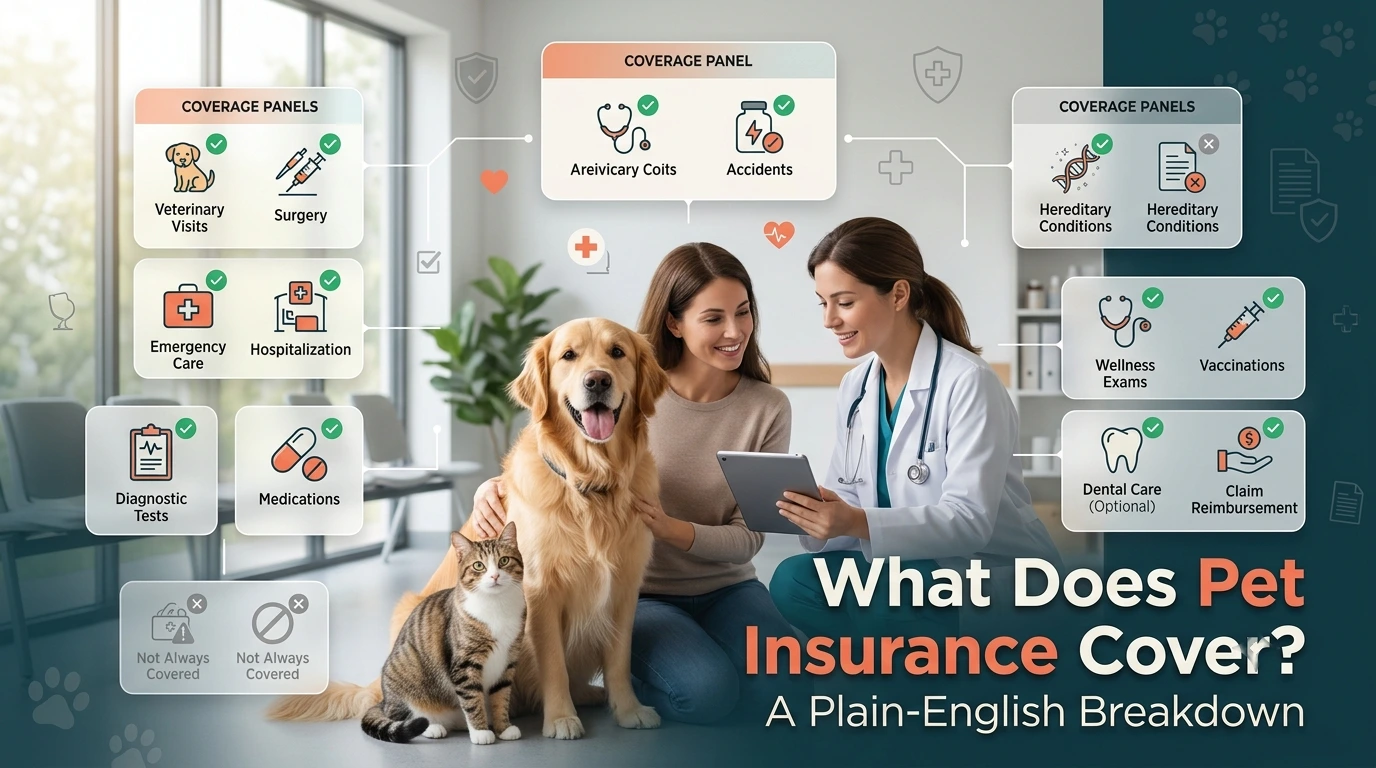
Direct Answer: Pet insurance generally covers accidents and illnesses — diagnostics, surgery, hospitalization, and medication — but the honest answer depends entirely on the policy, since routine care, pre-existing conditions, and cosmetic procedures are usually excluded unless you've added them specifically.
"What does pet insurance actually cover?" is one of those questions that sounds simple until you actually try to answer it. The honest response is: it depends entirely on the policy, and the gap between what people assume is covered and what's actually written into the fine print catches a lot of owners off guard right when they need coverage most — during an emergency, with a vet bill already in hand.
This guide walks through what a typical policy includes, where coverage commonly stops, how lifetime pet insurance differs from more limited alternatives, what multi pet insurance actually saves you, and how to run a real pet insurance comparison instead of just picking whichever ad you saw first.
Nearly every pet insurance policy starts with some version of accident and illness coverage, and this is genuinely the foundation worth understanding first.
Accidents typically include things like broken bones, swallowed foreign objects, bite wounds, poisoning, and injuries from falls or car accidents. These are usually covered from day one or after a very short waiting period, often just a day or two.
Illnesses cover a much broader category — infections, digestive problems, cancer, diabetes, allergies, and other diagnosed conditions that aren't the result of an accident. Illness coverage almost always comes with a longer waiting period than accidents, commonly around two weeks, meaning a condition diagnosed in the first days after enrollment likely won't be covered.
Within both categories, most comprehensive plans also cover diagnostic testing (bloodwork, X-rays, MRIs), surgery, hospitalization, prescription medication, and specialist referrals, as long as they're tied to a covered accident or illness.
This is where a lot of the confusion — and the disappointment — actually happens. A few categories are excluded by most standard policies:
The exclusions list matters just as much as, if not more than, the coverage highlights on a company's marketing page, so it's worth reading it directly rather than assuming your policy works the way a friend's does.
This distinction matters enormously for pets that develop an ongoing or chronic condition, and it's one of the most misunderstood parts of pet insurance shopping.
Lifetime pet insurance continues covering a diagnosed condition year after year, for as long as you keep renewing the policy, and your vet fee limit typically refreshes annually. If your dog is diagnosed with a chronic condition like diabetes in year two of the policy, lifetime coverage keeps paying toward that condition in year three, year four, and beyond, as long as the policy stays active.
Time-limited or maximum-benefit policies, by contrast, stop covering a specific condition once either a set time period has passed (commonly 12 months) or a maximum dollar amount has been paid out for that condition — whichever comes first. Once that limit is hit, the condition effectively becomes a pre-existing exclusion going forward, even under the same policy.
For a young, healthy pet, the practical difference between the two might not show up for years. But for owners specifically trying to protect against the cost of a long-term chronic illness, lifetime coverage is the structurally stronger option, even though it typically costs more per month than a capped alternative.
If you own more than one pet, multi pet insurance is worth looking into specifically, since most insurers offer some form of discount for insuring multiple animals under the same account. Typical discounts run somewhere in the 5% to 10% range per additional pet, though the exact figure and structure vary by provider — some apply it as a flat percentage off each policy, while others let you manage multiple pets under one shared account with a combined deductible or annual limit.
A few things worth checking before assuming multi pet coverage is automatically the better deal:
Whether each pet still gets fully independent coverage limits, or whether they're sharing a combined annual cap that could run out faster if more than one pet needs significant care in the same year. Whether the discount applies uniformly, or only to pets added after the first one. And whether combining pets under one account actually simplifies claims and billing, or just bundles the premium without much practical benefit beyond the discount itself.
For households with two or three pets, the discount alone is often worth the comparison, but it's worth confirming coverage limits per pet rather than assuming "multi-pet" automatically means "equally comprehensive for each animal."
A meaningful pet insurance comparison goes well beyond comparing the monthly price on two quote pages. To actually compare apples to apples:
Match the deductible, reimbursement percentage, and annual coverage limit across every quote you're comparing — a cheaper premium at a lower reimbursement rate isn't automatically a better deal. Check whether each plan uses an annual or per-condition deductible, since this structural difference can matter more than the premium itself over the life of a policy. Look specifically at how each plan handles chronic and hereditary conditions, since this is where lifetime coverage and time-limited coverage genuinely diverge in real-world outcomes. And factor in how each provider's pricing has historically increased as pets age, not just the starting quote for a young, healthy animal.
It's also worth comparing discount stacking. A number of insurers combine multi-pet discounts with other savings — paying annually instead of monthly, military or first-responder discounts, or membership through an employer or association — and stacking a couple of these can meaningfully lower your effective monthly cost without touching your actual coverage.
However a specific plan brands itself — some insurers market coverage tiers under names built around the idea of "protecting" your pet — the underlying question stays the same: what happens financially if your pet gets seriously sick or injured, and how much of that cost genuinely gets absorbed by the policy versus left to you. The marketing language around any pet protection plan matters far less than the actual deductible, reimbursement rate, exclusions list, and payout limit written into the policy document itself. Treat any branded "protection" tier as a starting point for comparison, not a guarantee of comprehensive coverage, until you've read the specifics.
A few habits make the whole process considerably less confusing:
Request the full policy document, not just the marketing summary, before enrolling — exclusions and waiting periods live in that document, not the highlight reel. Ask directly how the provider treats bilateral conditions (issues that can affect both sides of the body, like hip dysplasia or knee injuries), since this trips up a surprising number of claims. Confirm the waiting period for each coverage category, since orthopedic conditions in particular often carry a longer wait than standard illness coverage. And if you're insuring more than one pet, get quotes both as separate policies and as a bundled multi pet plan, so you can actually see whether the discount outweighs any limitations on shared coverage.
For a closer look at current providers and plan structures, Pet Insurance USA is a useful resource for comparing coverage details side by side before you commit to a policy.
What does pet insurance cover, in the end, comes down to the specific policy in front of you — not a general industry standard. Accidents, illnesses, diagnostics, surgery, and hospitalization make up the core of most plans, while routine care, pre-existing conditions, and elective procedures usually sit outside standard coverage unless you've added them specifically. The lifetime-versus-time-limited distinction matters enormously if your pet ever develops a chronic condition, and multi pet insurance can meaningfully lower costs for multi-pet households, as long as you confirm each animal still gets adequate individual coverage. Read the actual policy, not just the summary, and you'll go into ownership of that plan with realistic expectations instead of an unpleasant surprise at claim time.
This article is for general informational purposes only and isn't personalized insurance advice — coverage terms vary by provider, state, and individual policy, so review current documentation directly before enrolling.
For readers researching related topics, electric vehicle guidance in the UK may also be useful if you're comparing other major long-term purchase decisions.