
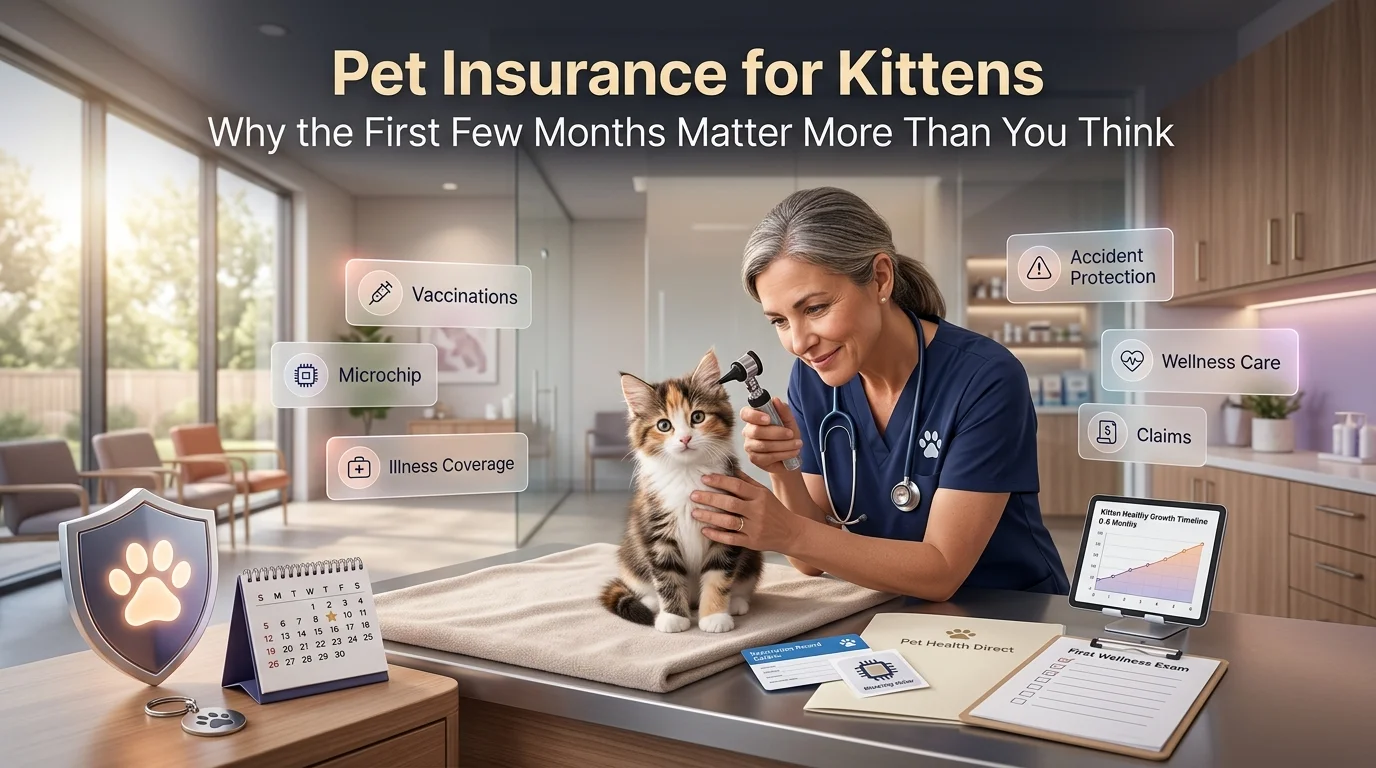
A new kitten comes with a predictable shopping list: food, a litter box, a scratching post, maybe a few toys destined to end up under the couch within a week. Insurance rarely makes that list, and that's usually a missed opportunity. The window right after you bring a kitten home is, in almost every practical sense, the cheapest and easiest moment you'll ever have to lock in coverage for that cat's entire life.
This guide walks through why timing matters so much with pet insurance for kittens, what actually drives cat insurance cost, how to find cheap cat insurance without gutting your coverage, and which U.S. companies are worth comparing if you want a provider that can insure your cat from kittenhood all the way through its senior years.
Every cat insurance policy excludes pre-existing conditions, meaning anything your cat showed symptoms of before the policy started won't be covered. A kitten enrolled at eight or ten weeks old has, essentially, a blank medical record. There's nothing yet for an insurer to exclude, which means the policy you buy on day one tends to offer the broadest possible coverage you'll ever get for that specific cat.
Wait a year or two, and the picture gets more complicated. Even a single vet visit for something minor, an ear infection, a bout of vomiting, a skin irritation, can end up noted in the medical record and excluded from coverage if it recurs later. None of this is really about the insurer being unfair. It's simply how the reimbursement model works: insurance is designed to cover unknown future risk, not conditions that are already on record.
There's a financial upside too. Premiums for young, healthy kittens are typically the lowest they'll ever be for that cat, since age is one of the strongest predictors of future claims. Locking in coverage early doesn't just protect against pre-existing exclusions, it also tends to mean a lower starting price point that many insurers use as the baseline for future renewals.
Not every policy is structured the same way, and knowing the differences helps you avoid paying for coverage you don't need or missing coverage you assumed you had.
Accident-only plans cover injuries like falls, cuts, or swallowed objects. They're the cheapest tier but leave illness entirely uncovered, which is a significant gap for cats prone to conditions like urinary blockages or kidney disease.
Accident and illness plans are the standard choice for most owners, covering injuries plus a broad range of illnesses, from infections to chronic conditions like diabetes.
Wellness or preventative add-ons layer coverage for routine, predictable costs like vaccinations, deworming, and annual exams onto a base plan, spreading those expected costs into a flat monthly fee rather than one lump payment at the vet.
Most cat insurance plans marketed toward kitten owners are some version of the accident-and-illness tier, often paired with a kitten-specific wellness package that covers the cluster of vaccines and preventative visits that happen in the first year of a cat's life.
A handful of factors combine to determine what you'll pay, and understanding them explains why two seemingly similar kittens can end up with noticeably different quotes.
Breed plays a role, though less dramatically than it does for dogs. Certain purebred lines, such as Maine Coons or Persians, carry known hereditary risks like heart conditions or kidney disease, which can push premiums slightly higher than a mixed-breed cat with a broader gene pool.
Age is one of the biggest factors of all. A kitten enrolled at two or three months old will typically see the lowest premium of its lifetime, with costs increasing gradually through adulthood and more steeply once the cat reaches its senior years.
Location affects pricing too, since veterinary costs vary significantly between regions, and insurers build that regional cost difference directly into their quotes. A cat insured in a major metro area will often cost more to cover than the same cat insured in a rural area.
Finally, your chosen deductible, reimbursement percentage, and annual payout limit have a direct and often underestimated effect on your monthly bill. A policy with a low deductible and 90% reimbursement will cost meaningfully more than one with a higher deductible and 70% reimbursement, even for the exact same cat.
Cheap cat insurance doesn't have to mean weak coverage, but it does usually mean making a deliberate trade-off rather than stumbling onto some hidden bargain plan. A few practical ways to lower your premium without gutting your protection:
The one area worth being cautious about cutting is the annual payout limit. A very low cap can turn an otherwise affordable plan into a policy that barely helps during a genuinely expensive emergency, which defeats much of the purpose of having insurance in the first place.
It's easy to think about pet insurance for kittens as a short-term decision, but the choice you make now shapes what your options look like a decade from now. Senior cat insurance becomes a much bigger consideration once a cat reaches roughly seven to ten years old, the point at which many insurers start reclassifying cats into a higher pricing tier and watching more closely for age-related conditions like kidney disease, hyperthyroidism, or arthritis.
Cats that were insured from kittenhood generally have a much smoother transition into their senior years, since their policy simply continues rather than requiring a brand-new application. Any condition that develops along the way is covered under the existing policy rather than being flagged as pre-existing by an insurer seeing that cat's medical history for the first time.
Owners who skip insurance during the kitten years and wait until their cat is already a senior often find their options considerably narrower. Some insurers cap the age at which they'll accept a new enrollment, and any existing condition, even something as common as mild kidney values on a routine bloodwork panel, can be excluded permanently. If you're in this position, it's still worth comparing a handful of providers, since senior-specific terms vary significantly, but the earlier version of this decision, back when your cat was still a kitten, would have been considerably simpler.
Several major U.S. providers offer coverage for kittens and operate across most states, though exact availability, minimum enrollment age, and plan structure vary by company, so it's worth checking current details directly before enrolling.
Rather than assuming any single company is universally "best," it's worth requesting quotes from three or four of these using your kitten's actual breed, age, and location, since pricing and coverage details shift enough between providers that a direct comparison is the only reliable way to judge value.
If you're feeling overwhelmed by the number of variables involved, a shorter, more structured process tends to work better than trying to evaluate every provider on the market:
The best time to think seriously about pet insurance for kittens is right now, while your cat's medical history is still a blank page. Whether you end up prioritizing cheap cat insurance to keep costs manageable, or a more comprehensive plan that carries smoothly into senior cat insurance down the road, the earlier you enroll, the more coverage options stay open to you. A few minutes spent comparing cat insurance plans today can spare you a much more limited, more expensive shopping experience years from now, right when your cat may need that coverage the most.